Adult Friendships: Why Does It Have to Be So Hard?
Think about the unspoken rules we have for romantic relationships:
Don’t double text.
Let them chase you.
Okay, now we’re exclusive.
What’s your love language?
I need you to text me more.
What do you actually want out of this relationship?
These are conversations we have so normally with our romantic partners. Yet, when it comes to friendships—where there are far more ambiguous "situationships" and undefined tiers—we rarely say these things out loud. Regardless of the fact that it is another relationship that is absolutely vital to our existence, there are so many unanswered questions.
How can we be a better friend? What are my boundaries? What does my platonic love language look like?
Because we rarely stop to ask these questions, we end up navigating our friendships blindly. As a result, we find ourselves unhappy in a long-lasting friendship, silently distancing ourselves from certain friends, or judging ourselves after a nasty friendship breakup for not being able to hold onto long-term connections.
The truth is, we all struggle with it. The friend that only texts you when they have an issue, the work bestie that you never talk to anymore after switching jobs, or the friend you love deeply but who completely drains your social battery. We all have the friend whose life stage has shifted so drastically that finding common ground feels like forcing a puzzle piece that no longer fits, or the one where you suddenly realize you are the only person initiating plans and keeping the connection alive. To be honest, I have been on either sides of most of these scenarios.
What makes this struggle even harder is the guilt we feel when a friendship fades. There is a strange social stigma that implies keeping your oldest friends is somehow a measure of success. We are taught that the sheer longevity of a friendship defines who we are as people. But the reality is, sustaining these bonds is freaking difficult.
Have you ever seen that graph showing how the average person spends their time as they age?
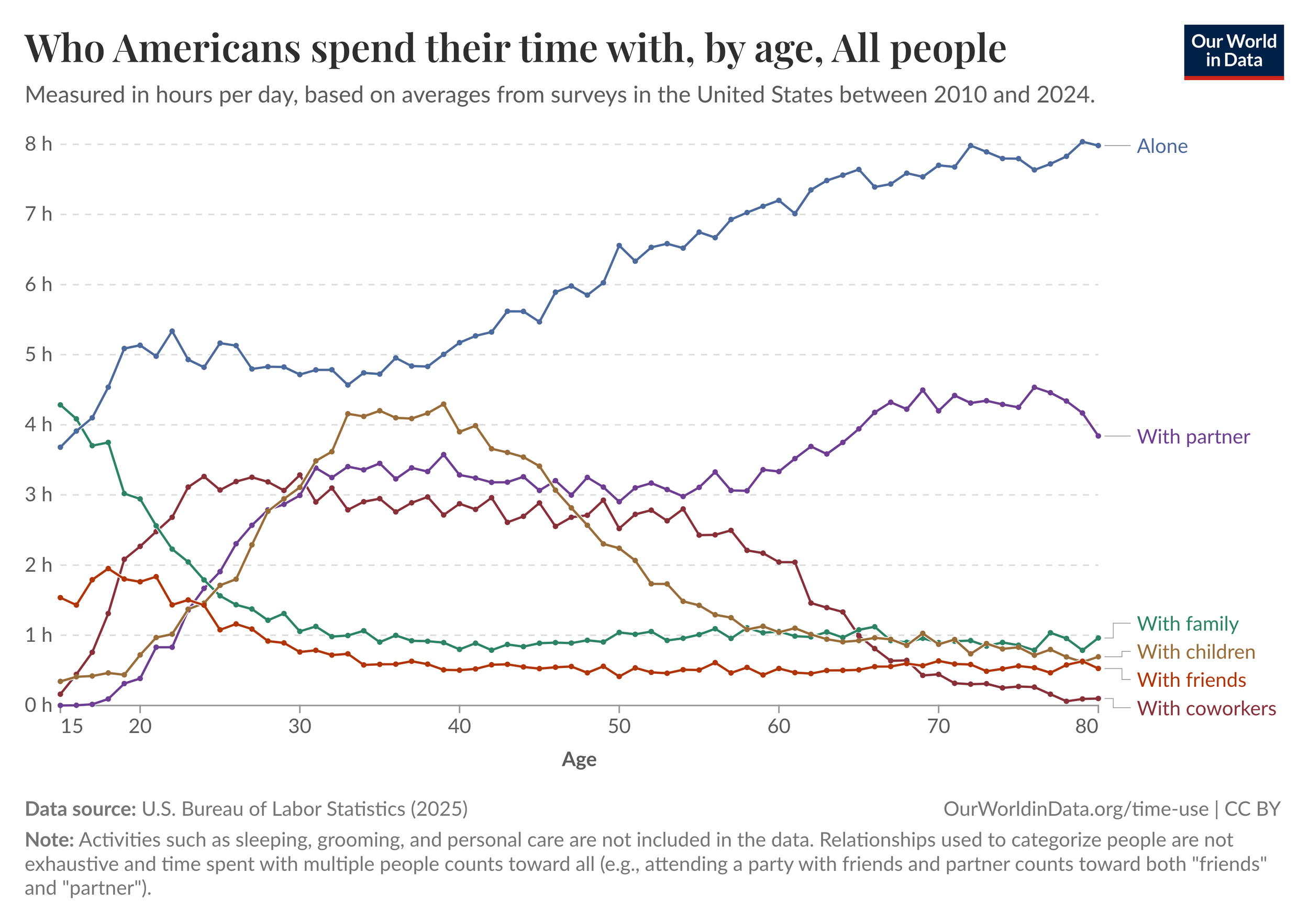
(See the graph here: Time Spent with Relationships by Age)
Time spent with family stays consistently high, and time with a partner increases from a certain age. But those groups usually consist of a set number of people. If you look at the time spent with friends, it drastically drops after your school years, falling way below the time we spend with coworkers. Yet, as adults, you probably have a collective group of friends you want to sustain from an earlier age and also have new groups of friends from new beginnings including work, partner’s friends and so on. Within these friends, you have the friends you want to see 1:1, the friends you want to see in groups and you genuinely want to honor all of those bonds. But we have so little time, and our lives are constantly changing. Sustaining these friendships is hard.
So, how do we do this well? How do we actually cherish these friendships? To be honest, I don’t have it all figured out, but I’ve listened to just about every major podcast that exists on YouTube regarding adult friendships and wanted to write on this—as a personal note, but also hoping that it could help anyone navigating the same issue.
Three Fundamentals of a Friendship
First, I want to establish the baseline. According to friendship expert Danielle Bayard Jackson, there are three things you fundamentally need to sustain an adult friendship: Symmetry, Support, and Secrecy.
Here is how that translates into the deeply complex world of adult relationships.
1. Symmetry
It’s the feeling of going, "omg, same." It’s the comfort of being on equal footing. If you feel an imbalance—like your friend is suddenly making better choices or moving ahead—remember that perceiving this shift is entirely subjective. It could have to do with your own insecurities, it could be your friend simply being a bit judgy, or it could just be exactly what you need to experience in that specific timeframe.
The thing is, as females, we have been compared to others since such an early age. We are practically embedded to compare ourselves. Research shows that girls' confidence drops by 30% between the ages of 8 and 14, leaving 60% of girls by the age of 14 lacking the confidence to make friends. It turns into a silent social and sexual competition. We constantly measure how we are doing by comparing ourselves to others: She got married before me. She has a better job than me.
The day and age we live in has made it so easy to find the differences rather than the commonalities. Our algorithmic world, which caters to our needs and personalizes every piece of information to our exact liking, has enabled us to find differences we didn't even need to talk about. We are so used to swiping right or left to make an immediate decision about whether we like something or agree with it. We constantly expect to provide immediate feedback.
But in human relationships, we cannot bring this curated mentality. We need to actively rewire our brains. Because if we need symmetry in friendships, our modern age is only making it infinitely more difficult for us.
2. Support
Second, we need emotional support. We expect a certain level of solidarity, but the problem is, we almost never articulate what kind of support we need, or what we need in any given moment. With females, we often rely on this mythical "sixth sense"—the expectation that we possess the emotional intelligence to just know what the other person needs.
Here is the truth: everyone is trying their best. People don't go about their day with the intention of not providing the best support to their friend. We all think we're doing a great job, even though one of us could be feeling a complete lack of support. But the one feeling unsupported sits there feeling like this other person should just know.
This miscommunication is worsened by the fact that we live in a very passive society today. Before, you had to actively go to Google or go to the library to do your own research and "fact check." Now, we are simply being fed all of this information, catered specifically to what the algorithm thinks we need.
This passive stance is dangerous. We need to be vocal about what we need. Put in the effort, make the time, and prioritize them. We talk so much about fighting for a romantic relationship to work, but we rarely apply that same effort to our friendships. We have to start working on our friendships with the exact same intentionality we bring to a partnership.
3. Secrecy
Lastly, secrecy. This doesn’t mean keeping secrets or gossiping, but rather feeling like there's this bubble—a secret, safe world you can feel between the two of you. It's about sharing your peace.
When that bubble breaks, it hurts. If you don't hear about a friend's promotion, or them struggling with grief you might feel like she never shares anything with you. But from the other person's perspective, they might have felt like they didn't need to tell you this piece of information because A. It’s not worth talking about and she probably doesn't care, or B. I don't want to burden my friend with this information.
However, people like you a lot more than you think, and they want to hear from you more than you think. In fact, psychological studies on a phenomenon called the "Liking Gap" show that people consistently underestimate how much their conversation partners actually like them and enjoy their company.
Navigating the Seasons of Friendship
Understanding what makes a friendship work is only half the battle; sustaining it requires a deliberate shift in how we approach these relationships. Here are a few mindset shifts that have helped me:
Accept that seasons change: In school, it was easy to tell seasons. Schools change, college changes. Now as adults, we don't have that. We have seasons changing—like a maturity of mind due to a sudden death in the family, or just genuine personal change—without us even knowing. As Mel Robbins points out, there are friends that are there for a reason, for a season, and for a lifetime. Don't force people into the wrong category, because when you do, that's when a breakup happens. Let them go, and let them grow. They might come back to you at a later time, but when you force a breakup, it makes that incredibly difficult.
Be creative: I get you. After a long day of chatting with coworkers, clients, and everyone else, you just want some "me time." Sometimes, a message from a friend isn't what you have the energy to respond to right then. Reciprocating and prioritizing can feel exhausting. But know that reciprocating doesn't always mean handing someone an orange just because they said they want an orange. They might just be craving something sweet. Ask them what it is they really need. Maybe you can offer them chocolate instead, because today, that’s all you have the energy to give. Find creative ways to show you care that don't completely drain your battery.
Stop taking count of your contributions: We tend to overestimate our own contributions and underestimate our friends' contributions. It’s not a competition, it’s about collaboration. Stop taking count, because real friends forget what they give.
Understand your values and set boundaries: The old advice says, "Be the friend you want to have." But wait—who is the friend that I actually want? You have to figure that out first. Understand your own values. Once you know what you are looking for in a friend, setting boundaries becomes so much easier. A real friend will understand and respect your boundaries.
To this day, I still think about the friend I broke up with years ago.
Especially as females, we deeply integrate friends into our lives. Their success is your success; their sadness is your sadness. And when someone you cared about so deeply is no longer in your life, you grieve and remain confused as to why it ended. It actually makes me feel sad thinking about this because it also reminds me of the kind of person I was: so insecure and always wanting something more.
But there is also peace in knowing that that period was necessary to become who I am today.
You can never replace a great friend—not like a boyfriend, anyway. But you need to cherish that they so happened to walk into that season of your life. And you hope it will be a longer season, reason next time or even for a lifetime, if they ever do stumble back into your life. And when they do, I hope I’m ready for it, and she is.
Podcasts to credit
The Adult Guide to Spotting Fake Friends (And Finding Real Ones)
LIES About Adult FRIENDSHIP And The TRUTH You Need To Hear | The Mel Robbins Podcast
Why Making Friends as an Adult Feels Impossible & What to Do About It
It’s Not You: The Real Reason Adult Friendship Is So Hard & 3 Ways to Make It Easier

Who am I?
My name is Shiho, working in big tech during the day, and a life/career coach in the early mornings and night.
Please find your slot with me here if you’d like to chat and see how we can work together.